Sun 24 May 2026

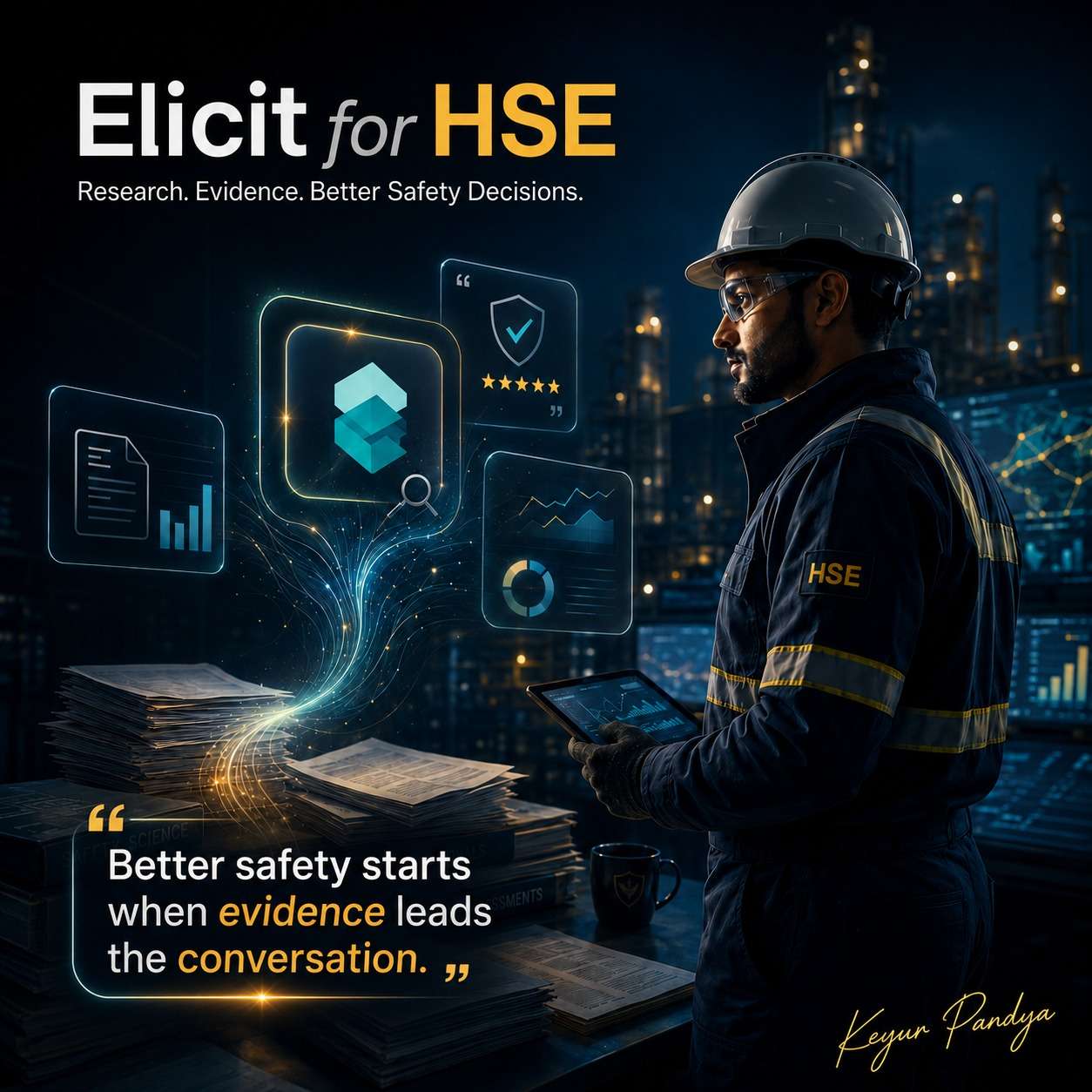
Elicit for HSE

Elicit for HSE: Bringing Research Evidence into Safety Decisions

In HSE, many discussions start with experience.
But better decisions come when experience is supported by evidence.

This week, let’s explore Elicit.

Elicit is an AI research assistant that helps us search, summarise, and compare academic research papers. It is useful when we want evidence on topics like heat stress, fatigue, human factors, ergonomics, chemical exposure, safety training, and incident prevention.

It is free to start, with a Basic plan available. The free plan includes limited access to its Research Agent, 2 automated reports per month, unlimited search across more than 138 million papers, summaries, chat with full-text accessible papers, source viewing, and Zotero import. Paid plans are available for deeper research, systematic reviews, collaboration, and higher limits.

How can we use it in HSE?
1. Evidence-based toolbox talks
Instead of preparing a generic toolbox talk on fatigue, we can search:
“What does research say about fatigue-related incidents in shift work?”

Then we can convert the findings into a practical talk:
What causes fatigue
What warning signs supervisors should notice
Which tasks become high-risk
What controls can reduce the risk

This makes the toolbox talk stronger than the usual “be careful” speech, which has somehow survived for decades despite doing very little.

2. Better training material
For topics like heat stress, manual handling, confined space entry, chemical exposure, or worker behaviour, we can use Elicit to find research-backed points.

Example:
“Find studies on effective heat stress prevention programs for industrial workers.”

Then we can use the findings to improve:
Training slides
Case studies
Quiz questions
Supervisor checklists
Awareness posters

3. Management briefing with evidence
When we propose a safety initiative, management may ask:
“What is the benefit?”

Elicit can help us collect research around safety climate, near-miss reporting, fatigue risk management, ergonomic interventions, or worker participation.

We can prepare a simple briefing:
Problem → Research evidence → Recommended control → Expected benefit → Implementation plan

This helps us move from opinion-based discussion to evidence-based decision-making.

4. Exam and professional learning
For NEBOSH, ASP, CSP, CFPS, and other HSE learners, Elicit can help explore deeper research around:
Human error
Risk perception
Fire safety
Safety leadership
Exposure control
Behaviour-based safety

We should still study from official course material. But Elicit can help us understand research behind the concepts.

Important reminder
Elicit is useful, but it does not replace standards, laws, company procedures, or professional judgement.

Academic research may not always match our site condition. Some papers may have access limits. AI summaries must be checked against the original source.

So the right approach is simple:
Use Elicit for research.
Use standards for compliance.
Use professional judgement for decisions.

Let’s use AI not only to write faster, but to think better.

Tool: Elicit
Access: Free to start, paid plans available
Best for: Research-based HSE learning, evidence-backed training, literature review, and exam preparation
Website: https://elicit.com

Note:
All previous AI Friday capsules are uploaded in our website https://jabharathsefoundation.org/artificial-intelligence-ai-tools-in-hse/