Thu 09 Jul 2026

Climate Trace

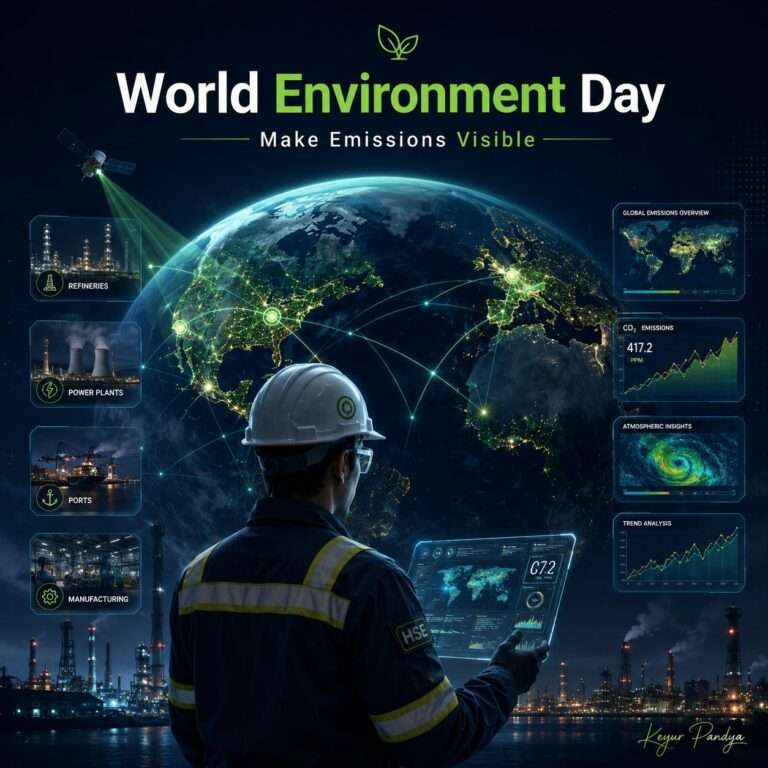
World Environment Day: Let’s Make Emissions Visible

Today, on World Environment Day, let’s move one step beyond slogans.

This year, World Environment Day focuses on climate change and the urgent signals the Earth is sending. UNEP’s 2026 campaign calls everyone to act #NowForClimate, with Azerbaijan hosting the global observance.

For HSE and Environment professionals, this is a good reminder:
We cannot manage what we do not measure.
And we cannot improve what we refuse to see.

This week, let’s explore Climate TRACE.

Climate TRACE is a free public platform that uses satellites, remote sensing, and artificial intelligence to provide a detailed view of greenhouse gas emissions across countries, sectors, and sources. Its emissions data is free and publicly available for download and API access.

Why is it useful for HSE and Environment professionals?

Many environmental discussions at site level still depend on assumptions, old reports, or beautifully formatted Excel sheets that nobody wants to disturb. Climate TRACE helps us bring open data into the discussion.

It may not replace official company monitoring or regulatory reporting, but it can help us ask better questions.

How can we use it practically?

1. Environmental awareness sessions
We can use the platform to show teams how emissions are linked to sectors such as:
* refineries
* power generation
* ports
* manufacturing
* transport
* waste
* oil and gas operations

This makes World Environment Day sessions more practical. Instead of only saying “protect the planet,” we can show where major emission sources come from and why environmental controls matter.

2. Management briefing and ESG discussion
HSE and Environment teams can use open emissions data to support early discussions on:
* carbon reduction priorities
* energy efficiency opportunities
* methane awareness
* flare and combustion sources
* contractor and supply chain sustainability
* climate risk communication

This can help management see environmental performance as a measurable issue, not just a poster competition with green leaves and suspiciously happy children.

3. Training young HSE professionals
For HSE officers, trainers, students, and exam aspirants, Climate TRACE can be used as a learning activity.

Example activity:
Select one country or sector → Review emission sources → Identify high-emission activities → Discuss practical control measures

This connects environmental theory with real-world data.

4. Supporting better site questions

A tool like this can help us ask:
* Which nearby sectors are major emission contributors?
* What environmental risks should we discuss in awareness sessions?
* Which operations need better monitoring or reduction planning?
* How can we explain climate impact in simple language to workers and supervisors?

Better questions often lead to better actions. Annoying, but true.

Important reminder
Climate TRACE is useful for awareness, research, benchmarking, and learning.

It does not replace:
* legal environmental monitoring
* stack emission testing
* company emission inventory
* regulator-approved reporting
* environmental impact assessments
* site-specific compliance data

Use it to improve understanding.
Use official site data and legal requirements for compliance decisions.

World Environment Day should not be only a celebration day.

It should be a reminder to make environmental risks visible, measurable, and actionable.

Because when emissions stay invisible, action usually stays optional.

Tool: Climate TRACE
Access: Free public platform
Best for: Emissions awareness, sustainability learning, environmental briefings, training, and climate discussions
Website: https://climatetrace.org

Note:
All previous AI Friday capsules are uploaded in our website https://jabharathsefoundation.org/artificial-intelligence-ai-tools-in-hse/

J&A BHF / GHF Annual Keval Shanti & Dr Pravin Patel - Mita Patel Students Scholarship Program 2026 | Last Date 31 Aug 2026 | Click Here