- 919866784338, 1(480)5807667
- info@jabharathsefoundation.org
- Saroor Nagar, Hyderabad 500035.
Thu 08 Oct 2026
Stop Searching Safety Research One Paper at a Time
This week, let’s explore Elicit, an AI research assistant designed specifically for finding, comparing and synthesizing scientific literature.
This is particularly relevant to Occupational Health, Industrial Hygiene, Human Factors, Ergonomics and evidence-based safety, where a confident AI answer is far less useful than knowing which research actually supports it.
Elicit was updated again on 30 June 2026, with a more capable Research Agent and revised usage limits. Its database currently covers more than 138 million academic papers.
What makes Elicit different from a normal AI chatbot?
Instead of simply asking:
“What are the effects of heat stress on workers?”
We can ask Elicit to search the scientific literature, identify relevant studies, summarise them and compare specific information across papers.
Its literature-review workflow can use both semantic search and keyword filtering. We can also organise papers by information such as study population, intervention, outcomes, study design and publication details.
That makes it interesting for our HSE fraternity.
Occupational Health research
Imagine we need evidence for a heat-stress programme.
Instead of browsing dozens of Google results, we can ask:
“What evidence exists on the effectiveness of work-rest schedules, hydration and cooling interventions for reducing occupational heat strain among outdoor workers in hot climates?”
We can then examine:
Paper → Population → Intervention → Outcome → Result → Limitations
This could support professionals researching:
Heat stress
Occupational noise
Fatigue and shift work
Ergonomics
Respiratory exposure
Workplace stress
Musculoskeletal disorders
Occupational health interventions
The research still needs competent interpretation. Elicit is a research assistant, not an occupational physician hiding inside a browser tab.
Investigating whether a safety intervention actually works
Suppose management asks:
“Does behaviour-based safety really reduce injuries?”
or
“Does toolbox training improve safety performance?”
Instead of asking a general-purpose AI model for an opinion, we can search the published evidence.
For example:
Find systematic reviews and peer-reviewed studies evaluating the effectiveness of toolbox talks on worker safety behaviour or occupational injury outcomes. Prioritise studies from 2020–2026. Show study design, workforce, intervention, measured outcome, main result and limitations.
We can then read the actual papers behind the conclusions.
Compare several studies quickly
Elicit can add structured information as columns against multiple papers.
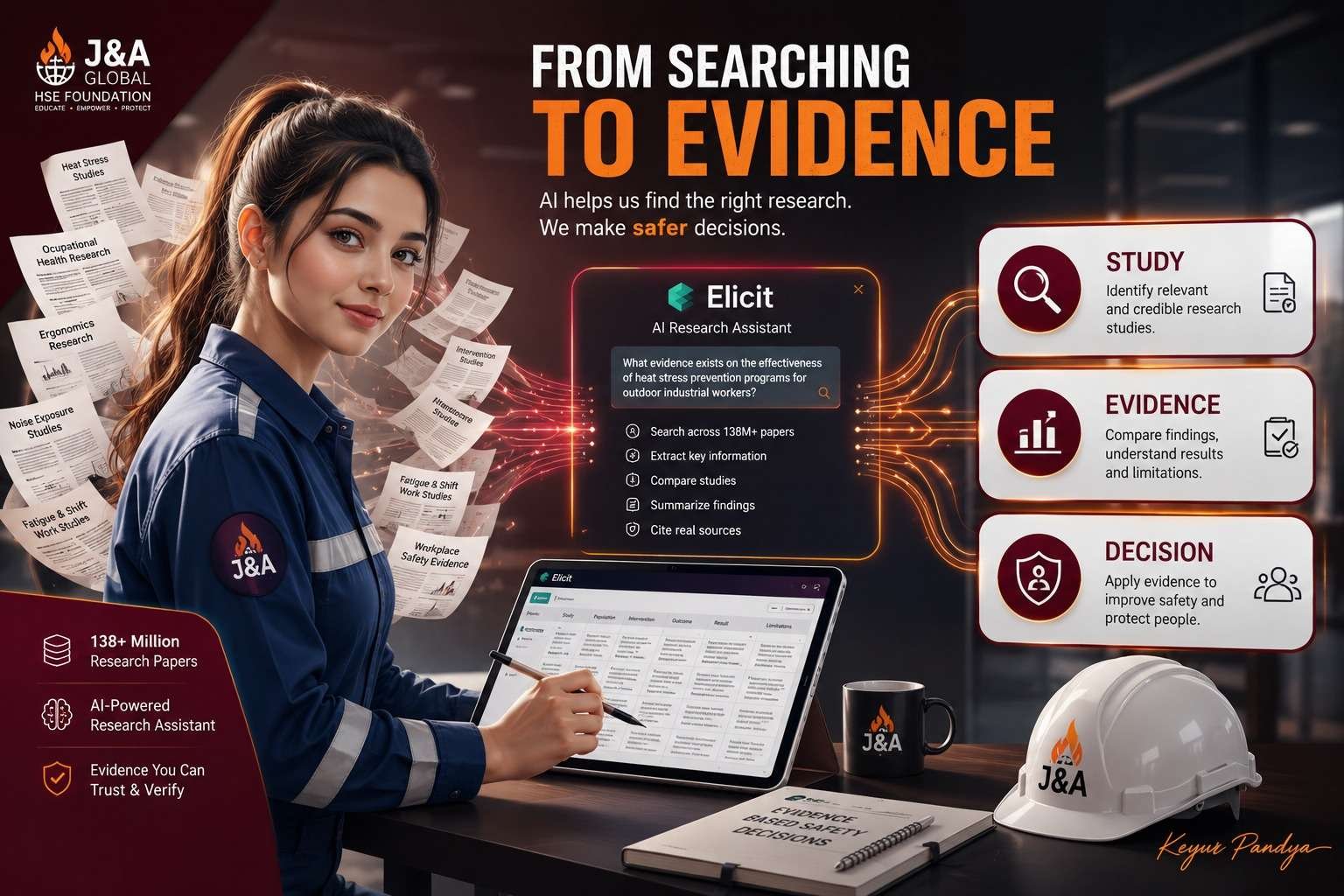
For an HSE research question, we could create:
Study | Industry | Country | Sample Size | Hazard | Intervention | Outcome | Finding | Limitations
This is particularly useful when preparing:
HSE presentations
Management proposals
Occupational health programmes
Literature reviews
Training material
Research assignments
Evidence supporting improvement initiatives
Useful for NEBOSH, ASP, CSP and CFPS learners
This may be one of the more meaningful AI uses for professional-development candidates.
Instead of asking AI:
“Explain fatigue management.”
Try researching:
“What factors are most strongly associated with occupational fatigue and safety incidents among shift workers?”
Then inspect the evidence and citations.
That develops something more valuable than memorising another generated answer: evidence-based thinking.
Is Elicit free?
Yes.
Basic: Free
The current Basic plan includes:
Unlimited searching across 138+ million papers
Unlimited summaries
Unlimited chat with papers where full text is available
Sources shown for generated answers
Zotero importing
Limited use of Research Agent and Research Reports
That is already sufficient for our fraternity to experiment with genuine literature searches.
For most HSE professionals trying it for the first time, the free plan is where I would start.
Pricing and limits evolve, so we should always confirm the live pricing page before subscribing.
How reliable is it?
Elicit is an independent Public Benefit Corporation that originated from the research organisation Ought.
It has also achieved SOC 2 Type II compliance. Elicit states that uploaded research data is encrypted in transit using TLS 1.2+ and at rest using AES-256-GCM.
There is also an interesting recent validation.
In May 2026, Elicit published an evaluation using 994 Cochrane systematic reviews as a benchmark. Its own evaluation reported high performance across literature search, screening and extraction tasks. These are company-reported evaluation results, so they should be understood in that context rather than treated as an independent certification of accuracy.
And regardless of the technology:
✅ Open the original paper
✅ Check the methodology
✅ Check population and industry relevance
✅ Distinguish correlation from causation
✅ Verify important numbers
✅ Prefer systematic reviews and stronger study designs where appropriate
Never copy an AI-generated research conclusion directly into an HSE standard or exposure-control programme.
⚠️ One data precaution
For our first trial, I recommend using Elicit primarily to search published scientific literature.
Do not casually upload confidential incident investigations, employee health information, exposure records or client documents.
Elicit explicitly states that Enterprise customer data is not used for model training, including by its contracted model providers. We should not automatically assume identical contractual protections for a personal free account.
A good experiment for today
Open Elicit and try:
“What does recent scientific evidence say about the effectiveness of heat-stress prevention programmes for outdoor industrial workers in hot climates? Prioritise systematic reviews and occupational studies published from 2020–2026. Compare study population, intervention, outcomes, key findings and limitations. Do not make recommendations beyond what the studies support.”
Then compare the experience with asking the same question in a general AI chatbot.
That comparison itself would be an excellent learning exercise.
Official website: Elicit https://elicit.com/welcome?utm_source=chatgpt.com
Official tutorials: Elicit maintains a YouTube channel with tutorials, demonstrations and research examples. https://www.youtube.com/@elicit-research
> A thought for our HSE fraternity
> “Good safety decisions need more than information. They need evidence we are willing to question.”
AI can help us find research faster.
Our professional responsibility is still to determine whether that research is credible, relevant and applicable to the people we are trying to protect.
> Let’s use AI not just to get faster answers, but to ask better questions.
Note:
All previous AI Friday capsules are uploaded in our website https://jabharathsefoundation.org/artificial-intelligence-ai-tools-in-hse/
Copyright © 2022 J&A Bharat HSE Foundation. All rights reserved
J&A BHF / GHF Annual Keval Shanti & Dr Pravin Patel - Mita Patel Students Scholarship Program 2026 | Last Date 31 Aug 2026 | Click Here