- 919866784338, 1(480)5807667
- info@jabharathsefoundation.org
- Saroor Nagar, Hyderabad 500035.
Thu 08 Oct 2026
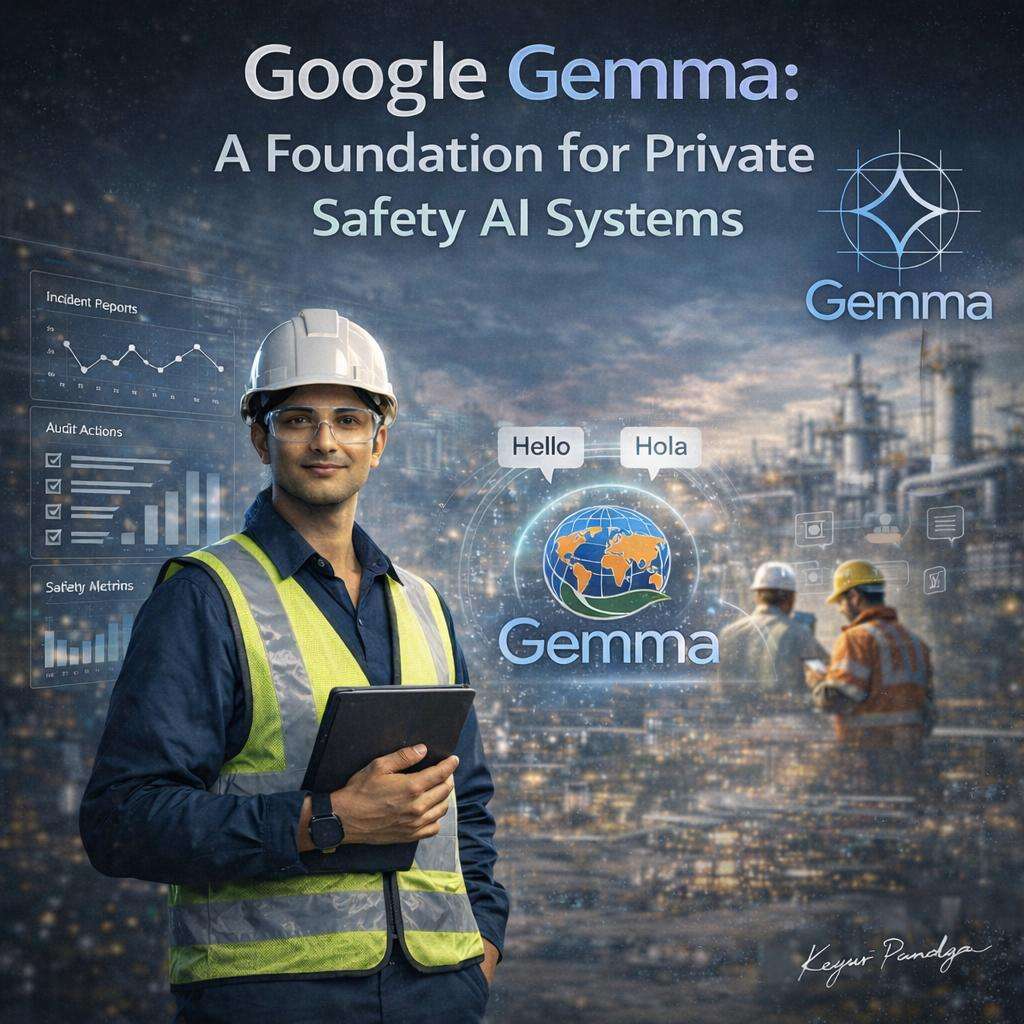
Today, let us look at Google Gemma. This is not a ready-made safety app like many people may expect after hearing the word “AI.” Gemma is Google’s family of open-weight AI models that organizations can tune and deploy in their own systems. Google’s release notes show that Gemma 4 was released on March 31, 2026, and Google describes Gemma as suitable for tasks like question answering, summarization, and reasoning.
So, does it relate to HSE?
Yes, but in a strategic way.
Gemma is useful for the HSE fraternity when we want to build private, custom, and domain-specific AI solutions instead of relying only on public chat tools. Google says Gemma models come with open weights and allow responsible commercial use, which makes them relevant for companies that want more control over their data, workflows, and internal safety knowledge.
Why this matters for HSE professionals?
Many of our safety documents are internal and sensitive. Think of SOPs, PTW rules, incident records, audit findings, emergency plans, inspection checklists, and training material. A model like Gemma can be used as the base for building an internal HSE assistant that searches, summarizes, explains, and organizes this knowledge inside the company environment. That makes it relevant for organizations that want AI support without exposing everything to public tools. This is an HSE-focused inference based on Google’s stated support for summarization, reasoning, project deployment, and tuning.
Practical HSE use cases
1) Internal safety knowledge assistant
We can use Gemma as the foundation for a private assistant that answers questions such as:
* What are the isolation steps before maintenance?
* What PPE is required for this chemical handling task?
* Which emergency actions apply to this alarm condition?
* What were the recurring causes in recent incident reports?
Because Gemma is designed to be deployed in our own applications, this kind of company-specific HSE helper becomes possible.
2) Multilingual safety communication
Google’s release notes show Translate Gemma was released on January 15, 2026, and the main Gemma page says it supports communication across 55 languages. For global HSE teams, this can be valuable for multilingual toolbox talks, training summaries, procedure explanations, and contractor communication. In industries where workers speak different languages, this kind of capability can help reduce misunderstanding.
3) Document and image understanding for field support
Google’s Gemma 4 model card says the model supports image understanding, including document/PDF parsing, chart comprehension, OCR, handwriting recognition, and screen/UI understanding. That opens interesting HSE possibilities such as reading scanned permits, extracting information from safety forms, reviewing charts, or helping teams search through field documents faster. Again, this is not a finished app by itself, but it is a strong base for building one.
4) On-device or edge-style safety support
Google presents some Gemma 4 variants as designed for mobile-first AI and for devices with strong compute and memory efficiency. That is relevant for the future of HSE because some safety use cases may need local or near-edge assistance in plants, remote sites, or mobile workflows where fast access matters.
But let us stay practical
For most everyday HSE professionals, Gemma is not something they will open and use directly tomorrow morning. It is more useful for:
* digital transformation teams
* internal IT teams
* software vendors building safety platforms
* enterprises that want private AI for HSE knowledge and workflows
So if our audience wants a simple daily-use tool, Gemma is not the easiest topic. But if we want to discuss the future of private AI in HSE, then Gemma is very relevant.
One important caution for HSE
Google’s Gemma 4 model card also makes it clear that responsible use, monitoring, safeguards, privacy care, and human review remain important. In HSE terms, that means AI can support safety work, but it should not replace professional judgement, field verification, legal review, permit controls, or emergency decision-making. That principle remains unchanged.
Our takeaway this Friday
Google Gemma may not be a ready-made HSE tool, but it is a strong foundation for building private and practical AI solutions for safety systems.
This is where it becomes relevant for our fraternity:
not as a chatbot trend, but as a possible engine behind the next generation of internal HSE assistants, multilingual safety support, and smarter document-based safety workflows.
Note:
All previous AI Friday capsules are uploaded in our website https://jabharathsefoundation.org/artificial-intelligence-ai-tools-in-hse/
Copyright © 2022 J&A Bharat HSE Foundation. All rights reserved
J&A BHF / GHF Annual Keval Shanti & Dr Pravin Patel - Mita Patel Students Scholarship Program 2026 | Last Date 31 Aug 2026 | Click Here