- 919866784338, 1(480)5807667
- info@jabharathsefoundation.org
- Saroor Nagar, Hyderabad 500035.
Mon 16 Nov 2026
Turn an HSE Workshop into an Action Map with Miro AI
Many useful HSE discussions still end with sticky notes, whiteboard photos and someone later trying to remember what everyone agreed.
Miro AI can help organise that information directly on a collaborative visual board.
Its current AI tools can cluster sticky notes, summarise selected notes, generate documents, tables and diagrams, and work with board content as context through its Sidekick assistant.
Where can we use it?
Incident-learning workshop
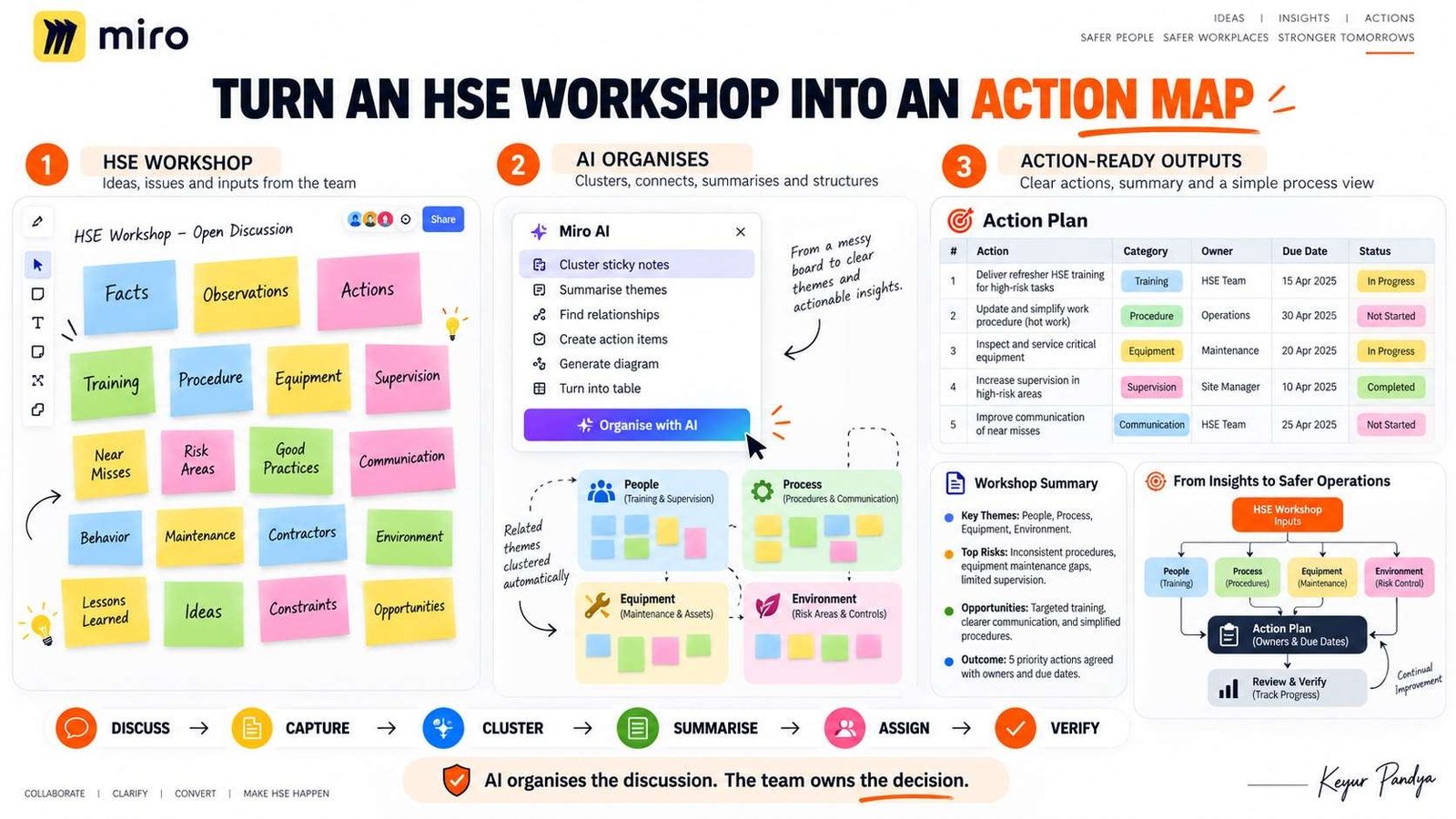
Team members capture:
Facts | Observations | Contributing factors | Actions
Select the notes and let Miro AI group similar points or summarise the discussion.
Then the investigation team reviews the result and confirms what is actually supported by evidence.
AI organises. Investigators conclude.
Miro specifically supports AI clustering of sticky notes by keywords and generating summaries from selected notes.
JSA / Risk-assessment workshop preparation
Map:
Job steps → Hazards → Existing controls → Questions to verify
Miro can help turn workshop information into a visual diagram.
But the important boundary remains:
The board can structure the discussion. It cannot determine whether the risk is acceptable.
A useful Miro feature
Miro’s current Sidekick can use selected objects on the board as context. Miro describes this simply as:
“The canvas is your prompt.”
So instead of repeatedly copying workshop notes into another chatbot, we can work directly from the visual discussion already created by the team.
Free or paid?
Miro has a genuine Free plan with:
3 editable boards
Unlimited team members
Limited Miro AI access
AI diagrams, tables and summaries
Limited Sidekick and Flow access
Starter is currently US$8/member/month when billed annually and adds unlimited/private boards and more collaboration features.
Miro also allows Free and Starter users to try Flows, but currently limits them to five Flow runs per team member, and those five runs do not reset.
What about HSE data?
Miro states that customer data submitted to its AI features is not used to train or fine-tune AI models. Its documentation also says AI interaction data may be used for feature improvement only under controlled conditions, with opt-in settings applicable to non-enterprise users and de-identification safeguards.
Miro currently reports certifications including ISO/IEC 27001, ISO/IEC 42001 and SOC 2 Type II.
Still:
✅ Remove unnecessary personal information
✅ Avoid confidential incident evidence unless authorised
✅ Verify every AI-generated summary
✅ Keep technical judgement with the HSE team
The practical workflow
DISCUSS → CAPTURE → CLUSTER → SUMMARISE → ASSIGN → VERIFY
“AI can organise the discussion. The team must own the decision.”
That is where I see Miro AI being genuinely useful for incident reviews, audit close-outs, risk workshops and management meetings.
It does not replace the HSE workshop.
It may help us leave the workshop with something more useful than a photograph of the whiteboard.
Note:
All previous AI Friday capsules are uploaded in our website https://jabharathsefoundation.org/artificial-intelligence-ai-tools-in-hse/
Copyright © 2022 J&A Bharat HSE Foundation. All rights reserved