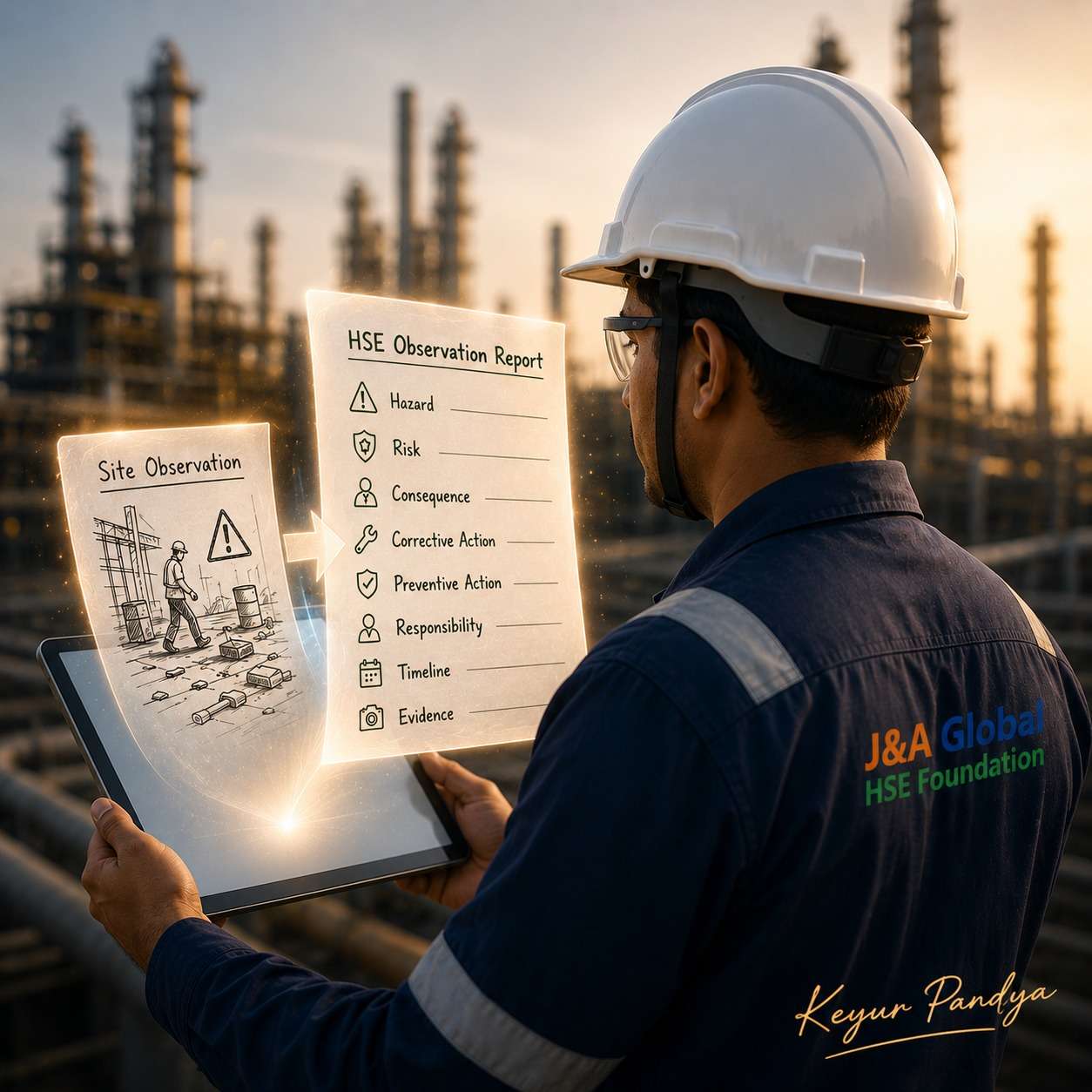
Do not write only:
“Housekeeping poor.”
Write it properly:
“Scrap material and cable pieces were found scattered near the walkway beside the maintenance workshop. Workers were using the walkway during shift change.”
The second version gives AI enough context to create a useful report. Shocking, I know. Even AI needs proper information.
Before using the prompt, try to mention:
Exact location
Work activity
People exposed
Equipment involved
Unsafe condition noticed
Possible immediate concern
Example
Observation:
Alternate bolts are missing from a flange joint on a wastewater line operating at 7 bar pressure.
AI can help convert it into:
Hazard: Incomplete bolting on a pressurized flange joint.
Risk: Joint may leak or fail under pressure.
Possible consequence: Personnel injury, wastewater release, equipment damage, or environmental contamination.
Immediate action: Barricade the area, restrict access, inform operations and maintenance, and inspect the line condition.
Preventive action: Add flange bolting verification in maintenance A checklist before startup.
Closure evidence: Corrected flange photo, inspection checklist, maintenance confirmation, and supervisor verification.
Useful Follow-Up Prompt
After AI gives the first report, use this:
Now improve this report for management review. Keep it short, practical, and action-focused. Remove repeated points. Add a clear CAPA table with responsibility, timeline, and closure evidence.
This second step usually gives a cleaner and more professional result.
AI will not replace our site judgment.
But it can help us convert rough observations into clear, reportable, action-focused CAPA.
Because safety observation is not just about finding problems.
It is about making sure action is taken.
Let’s use AI where it saves time and improves clarity.
Prompt smarter. Report better. Act faster.
Note:
All previous AI Friday capsules are uploaded in our website https://jabharathsefoundation.org/artificial-intelligence-ai-tools-in-hse/